

.png)
.png)

Rattan Dining Sets: Sizes, Shapes & Guide
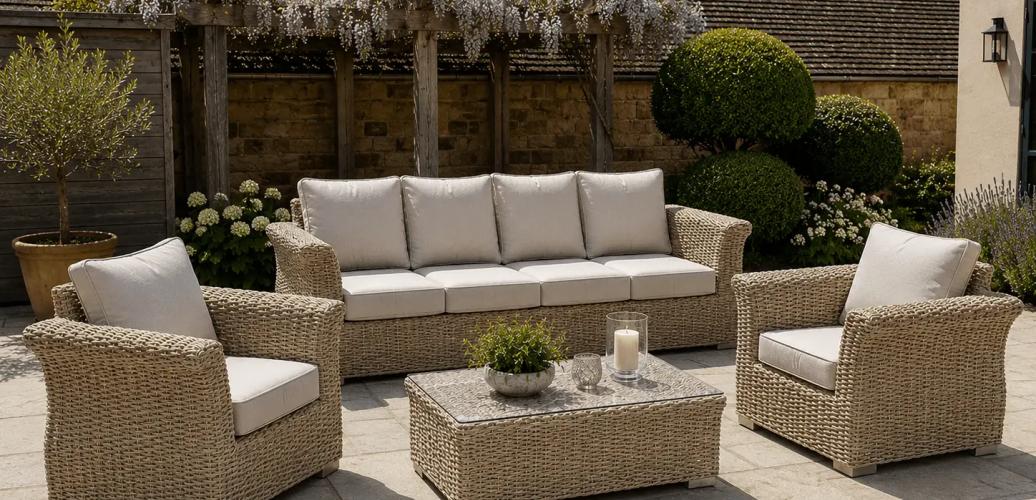
Picking a rattan dining set in the UK comes down to more than colour and style. The real decision is size, shape and seat count. Get that wrong on a Costa del Sol terrace, and you end up with a table you can't push a chair back from, or a set that looks lost in a large garden. This guide walks through how to match a rattan dining set to your actual outdoor space, before you even start comparing finishes. For a broader look at materials and ranges, our full rattan furniture buying guide is worth a read first.
Choosing the Right Rattan Dining Set Size for Your Terrace or Garden
Before picking a shape or seat count, measure your space properly. Start with the total footprint available. Then subtract at least 60 - 80 cm of clearance on every side, so chairs can pull out and people can walk past comfortably. On a covered terrace, factor in support posts, planters and any barbecue or outdoor kitchen unit already in place.
Many buyers underestimate how much room a dining set needs once the chairs are in use, not just when pushed in. A table that fits neatly on paper can still leave a walkway too narrow once six chairs are pulled back at once. Sketch the space, or mark it out with tape, before ordering.
Small Terraces and Balconies: 4 Seater Rattan Dining Sets
A narrow Marbella-style balcony terrace typically suits a compact round 4 seater set. These sets keep a small footprint while still giving two couples, or a small family, a proper place to eat outdoors. Round tables also avoid sharp corners that eat into tight walkways.
If even a 4 seater feels like too much furniture for the space, a taller, narrower format such as bar height dining sets for smaller terraces can be a practical alternative.
Larger Gardens: 6 and 8 Seater Rattan Dining Sets
A walled villa garden on the Costa del Sol usually has the depth for a rectangular 8 seater set, often with a bench option along one side to save space. Villas and townhouses with a dedicated dining terrace, rather than a balcony, are where these larger footprints make sense. If you regularly host extended family or entertain groups, this is the size bracket to plan around.
Round vs Rectangular Rattan Dining Tables: Which Shape Fits Your Space
Shape matters as much as size. A round rattan dining table and a rectangular one suit different spaces, different guest counts and different conversation styles.
Round Rattan Tables for Tight or Awkward Corners
Round tables work well in corner terraces, under a pergola with fixed posts, or anywhere the space isn't a clean rectangle. They also encourage conversation, since everyone faces roughly the same central point rather than sitting spread along a long edge. For a 4 seater rattan dining set on a smaller terrace, round is usually the easier fit.
Rectangular and Extending Tables for Entertaining
Rectangular and extending rattan tables suit villa gardens where the priority is fitting more people in, especially for entertaining. An extending table gives you flexibility: a smaller footprint for everyday use, with the option to open it out when guests arrive. Bench seating along one side of a rectangular table is another way to add capacity without extra chair clutter. That's useful where seat count matters more than a symmetrical layout.
Rattan Dining Set 6 Seater: A Popular Middle Ground
For most Costa del Sol villas and townhouses, the 6 seater rattan dining set is the most requested configuration. It sits comfortably between a compact 4 seater and a larger 8 seater. It gives enough seats for a household plus regular guests, without needing the depth of garden an 8 seater demands.
A 6 seater rattan dining table and chairs set typically works on a medium terrace or a garden dining area of moderate depth. It's not quite balcony-sized, but it doesn't need the space of a full villa lawn either. It's a sensible default if you're unsure between sizes, particularly if your household size changes through the year with visiting family.
Colour and Weave Options: Grey, Brown and Natural Rattan Dining Sets
Colour is often the last decision buyers make, but it has a big effect on how a set reads against your property. A grey rattan dining set tends to suit modern villa exteriors, especially those with white render, glass balustrades or minimalist landscaping. Grey weaves read as contemporary and blend easily with most outdoor colour schemes.
Brown and natural rattan tones, by contrast, sit more naturally against traditional Andalusian courtyards, terracotta tiling and older stone or render finishes. If your property leans traditional rather than modern, a natural or brown weave will generally look more at home than grey.
Colour can be hard to judge from a screen, particularly under different lighting. The Estepona showroom lets buyers sit at 4, 6- and 8-seater rattan tables and compare grey, brown and natural weaves side by side before committing to an online order.
All-Weather Synthetic Rattan vs Natural Cane
All-weather rattan, made from an HDPE synthetic weave, resists UV fading and moisture damage through the intense Spanish summer. Natural cane weaves, in contrast, only suit covered or indoor-adjacent spaces. A natural cane set left on an open terrace through summer will degrade far faster than synthetic weave. If your rattan garden dining set in the UK will sit uncovered, all-weather synthetic weave isn't optional. It's the baseline requirement.
Protecting Cushions and Table Tops Year-Round
Even weatherproof rattan benefits from some care. Bring cushions inside or under cover when not in use. Prolonged direct sun fades fabric faster than the frame beneath it. Wipe glass or resin table tops down regularly to stop salt residue building up near the coast. For full seasonal care steps, caring for rattan furniture in the Spanish sun covers the detail without repeating it all here.
If you're still weighing up rattan against another material entirely, how rattan compares to aluminium dining furniture is a useful comparison before you commit either way.
0 comment(s)